Engraved Pistol Grips: When the Art Becomes the Texture | Wicked Grips
Posted by Ed strange on Aug 27th 2026
The Art Is the Texture: Why We Engrave Our Pistol Grips Differently
There are easier ways to put texture on a pistol grip.
Diamonds. Checkering. Lines. Dots. Hexagons. Repeating geometric patterns.
Give a CNC machine the proper programming and it can repeat those shapes across a grip panel with incredible precision.
There is absolutely nothing wrong with that approach. In fact, it works extremely well.
We just wanted to do something different.
At Wicked Grips, many of our engraved pistol grips begin with a completely different idea:
What if the artwork itself became the grip texture?
Instead of designing a decorative image and then adding conventional texture around it, we began creating artwork that could perform both jobs.
It had to look like art from across the room.
And when you picked it up, it had to feel like a grip.
That simple idea has influenced some of our most recognizable designs and has become a major part of the way we approach custom 1911 grips, Beretta grips, CZ grips and other metal pistol grips.
There Is a Difference Between Machining a Pattern and Creating a Design
CNC machining is an incredible manufacturing technology.
It allows manufacturers to produce extremely precise and repeatable parts, including very effective grip textures.
A conventional texture can often begin with relatively simple geometry.
Create a diamond.
Repeat it.
Create a hexagon.
Repeat it.
Create intersecting lines.
Repeat them.
The pattern can be aggressive, mild, coarse or fine depending upon its dimensions.
For a strictly functional grip surface, that can be an excellent solution.
But that's not the question we're usually asking when we start designing a new Wicked Grips pattern.
We're asking:
Can we make something nobody expects to see on a pistol grip—and still make it work as a pistol grip?
That's a much more complicated problem.
First, Someone Has to Create the Artwork
A CNC machine doesn't have an imagination.
It is exceptionally good at doing exactly what you tell it to do.
But someone still has to decide what it should create.
Many Wicked Grips engraved designs begin as original artwork created specifically for our products.
That may be a character, historical influence, geometric concept, gothic composition or something that simply started as a sketch we thought would look incredible carved into metal.
Designs such as Valkyrie and Pax Per Mortem weren't selected from a catalog of standard grip textures. They began as artwork.
Wicked Grips artist Kade Strange created the original art, which we then adapted for deep engraving into our metal grips.
But creating an illustration is only the first step.
Artwork that looks great on paper doesn't automatically make a great pistol grip.
Our 1911 Aluminum Valkyrie: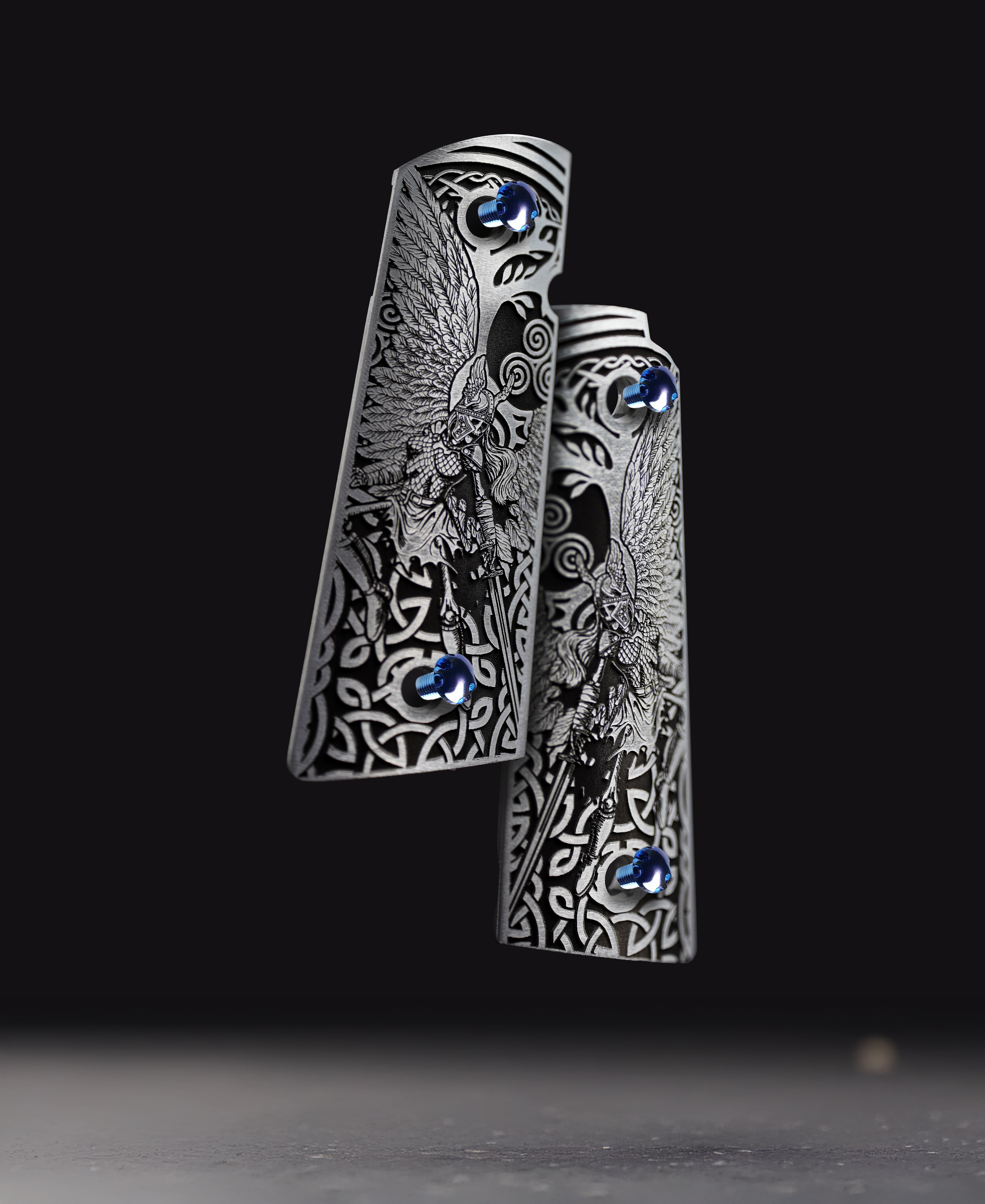
A Pistol Grip Is a Very Strange Canvas
Artists normally get rectangles.
A pistol grip gives you screw holes, frame contours, safety clearances, edges, cutouts and a relatively small amount of usable space.
And that space changes dramatically depending upon the platform.
A 1911 grip doesn't have the same proportions as a Beretta grip.
A Beretta 92XI or 92X Performance grip presents a completely different canvas.
A CZ Shadow 2 grip changes the proportions again.
So taking artwork and simply shrinking it until it fits doesn't work.
Important portions of the design can land underneath screws.
Critical details can disappear around edges.
Lines that looked dramatic in a large illustration may become too small to engrave effectively.
And an area that looks fantastic visually might create an uncomfortable pressure point once it's machined deeply into metal.
The art has to be redesigned for the object.
That's where illustration starts becoming industrial design.
Then the Art Has to Become Texture
This is the part we find most interesting.
A conventional engraved image can be mostly visual.
Our goal with many Wicked Grips designs is different.
We want you to feel the artwork.
That means thinking about depth.
Spacing.
Raised surfaces.
Recessed surfaces.
Edges.
Transitions.
The direction of individual elements.
How those elements interact with the fingers and palm.
And how aggressive the finished grip should be.
A line in an illustration isn't just a line anymore.
Once we machine that line into aluminum, copper or titanium, it becomes a physical feature.
Make it too shallow and you lose the tactile effect.
Make certain areas too deep or too sharp and they may become unnecessarily aggressive.
Put too much engraving in the wrong place and the design can become visually busy or uncomfortable.
There is a balance between art, texture and ergonomics.
Finding that balance is the hard part.
That's Why We Say "The Art Is the Texture"
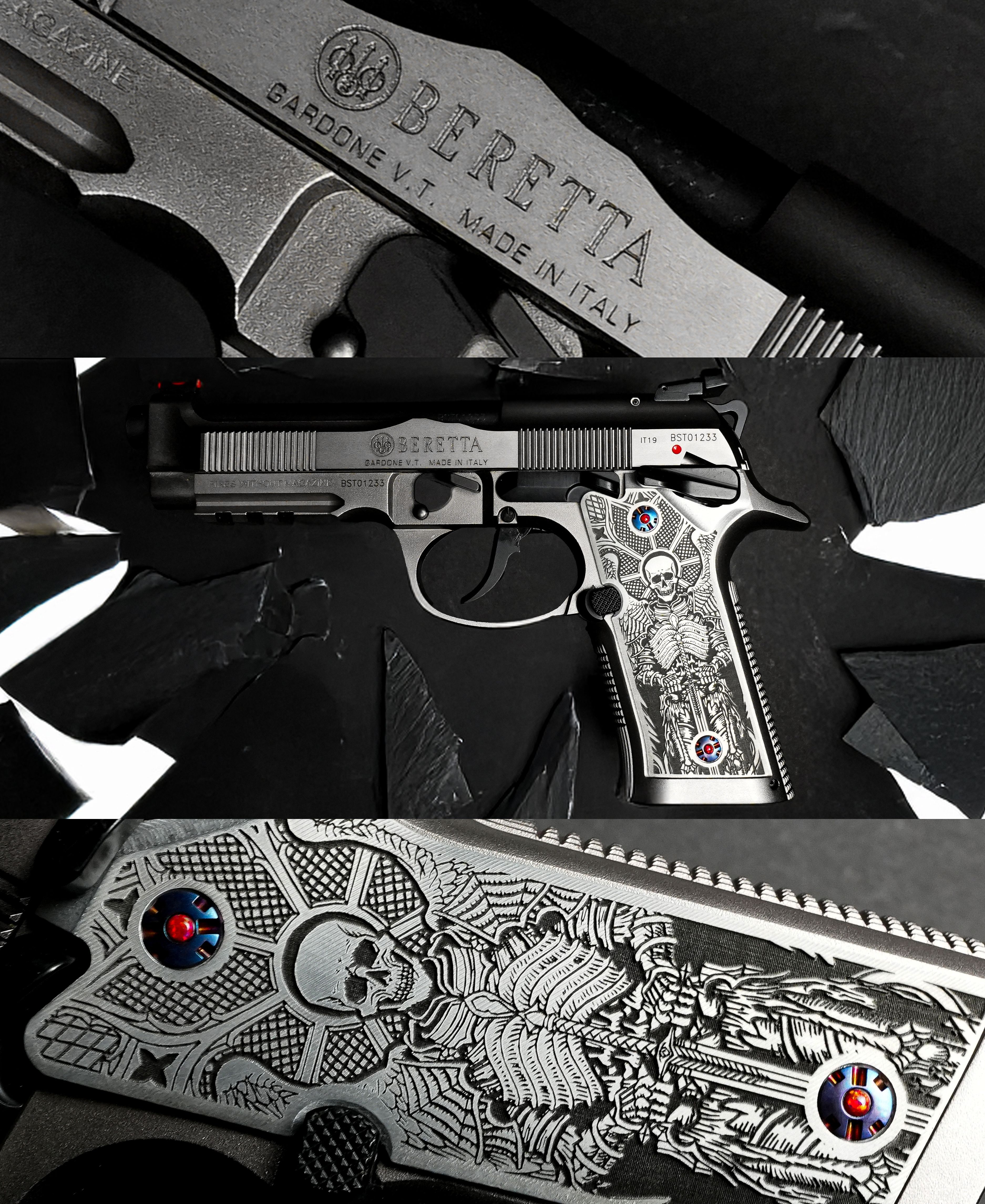
Take one of our Pax Per Mortem designs.
At first glance, you're looking at artwork.
There are faces, shapes, lines and details creating the composition.
But look closer.
Those same engraved elements create peaks, valleys, edges and recessed areas across the grip.
When the grip is in your hand, those features become texture.
The same basic philosophy is used in our Valkyrie designs. Wicked Grips offers the pattern in deeply engraved aluminum as well as Grade 5 titanium, where the original artwork becomes part of the physical surface of the grip.
In other words:
We didn't create a piece of art and then put grip texture behind it.
We designed the art to become the grip texture.
That distinction is important to us.
Pax Per Mortem Close up: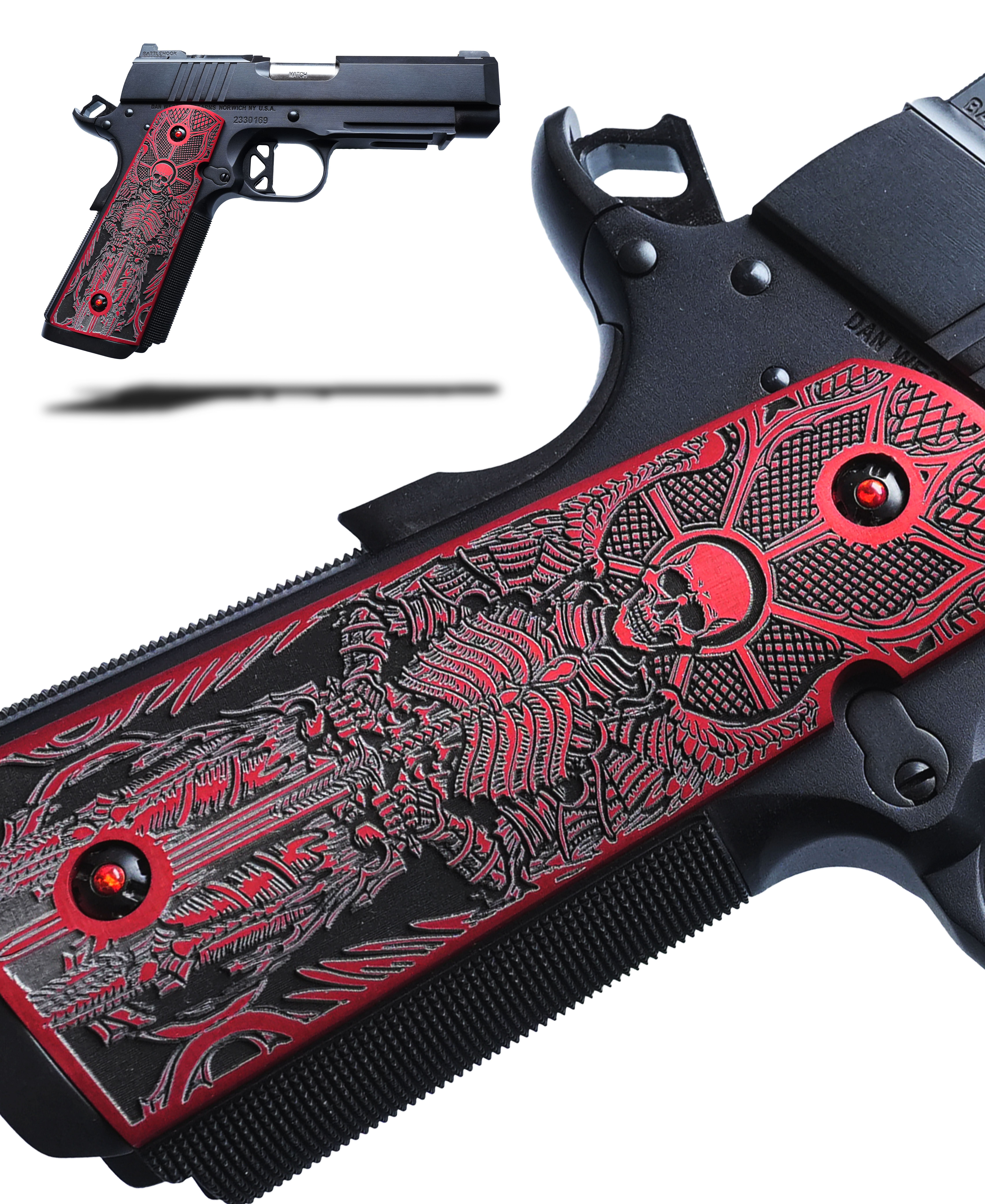
Deep Engraving Changes Everything
There is also a major difference between marking the surface of a grip and physically engraving a design deeply into the material.
A shallow engraving can create beautiful visual detail.
Deep engraving creates dimension.
Now light interacts with the design differently.
Recessed areas become darker.
Raised areas catch highlights.
A two-dimensional illustration develops shadows and depth.
And depending upon the design, your hand can actually feel those same contours.
This becomes especially interesting when we combine deep engraving with different materials and finishes.
Aluminum Gives Us a Different Canvas
Our engraved aluminum pistol grips allow us to machine relatively complex artwork into a lightweight metal platform and then use finishes to create additional contrast.
Anodized colors, PVD finishes and contrasting engraved areas can dramatically change the appearance of exactly the same underlying artwork.
A pattern can feel completely different visually in black, red, flat black or another finish even though the engraving itself hasn't changed.
That gives us another creative tool.
The material becomes part of the design.
Copper Adds Character
Copper takes the same concept in another direction.
Deep engraving already creates shadows and physical depth.
Copper adds natural warmth, color variation and the ability to develop patinas.
A recessed portion of an engraving can hold darker oxidation while raised portions can be selectively polished to expose brighter copper.
With finishes such as our Shipwreck patina, blues, greens, turquoise, dark oxidation and exposed copper can develop across the engraving differently on every set.
Now there are three things interacting:
The artwork.
The engraving.
The patina.
The final appearance isn't simply printed onto the grip.
It exists in the material itself.
Titanium Creates Yet Another Effect
Grade 5 titanium gives us another completely different canvas.
Titanium can be machined and deeply engraved while also allowing us to create dramatic colors through anodizing and specialty finishing.
The result can range from relatively restrained metallic tones to vivid blues, violets, bronze and multicolored effects.
Our titanium Valkyrie grips, for example, combine the original engraved artwork with the natural characteristics and finishing possibilities of titanium.
Again, the material isn't an afterthought.
It's part of the artwork.
Why Not Just Use a Basic Texture?
Sometimes we do.
There are applications where a straightforward functional texture makes perfect sense.
But Wicked Grips has never really been about finding the easiest way to make another version of something that already exists.
When we began making pistol grips more than two decades ago, customization was the point.
We like experimenting with unusual materials.
We like figuring out finishes.
We like creating designs that probably make our machinists wonder why we couldn't have just made some diamonds and called it a day.
Because anybody can make diamonds.
We want to make something that makes you look twice.
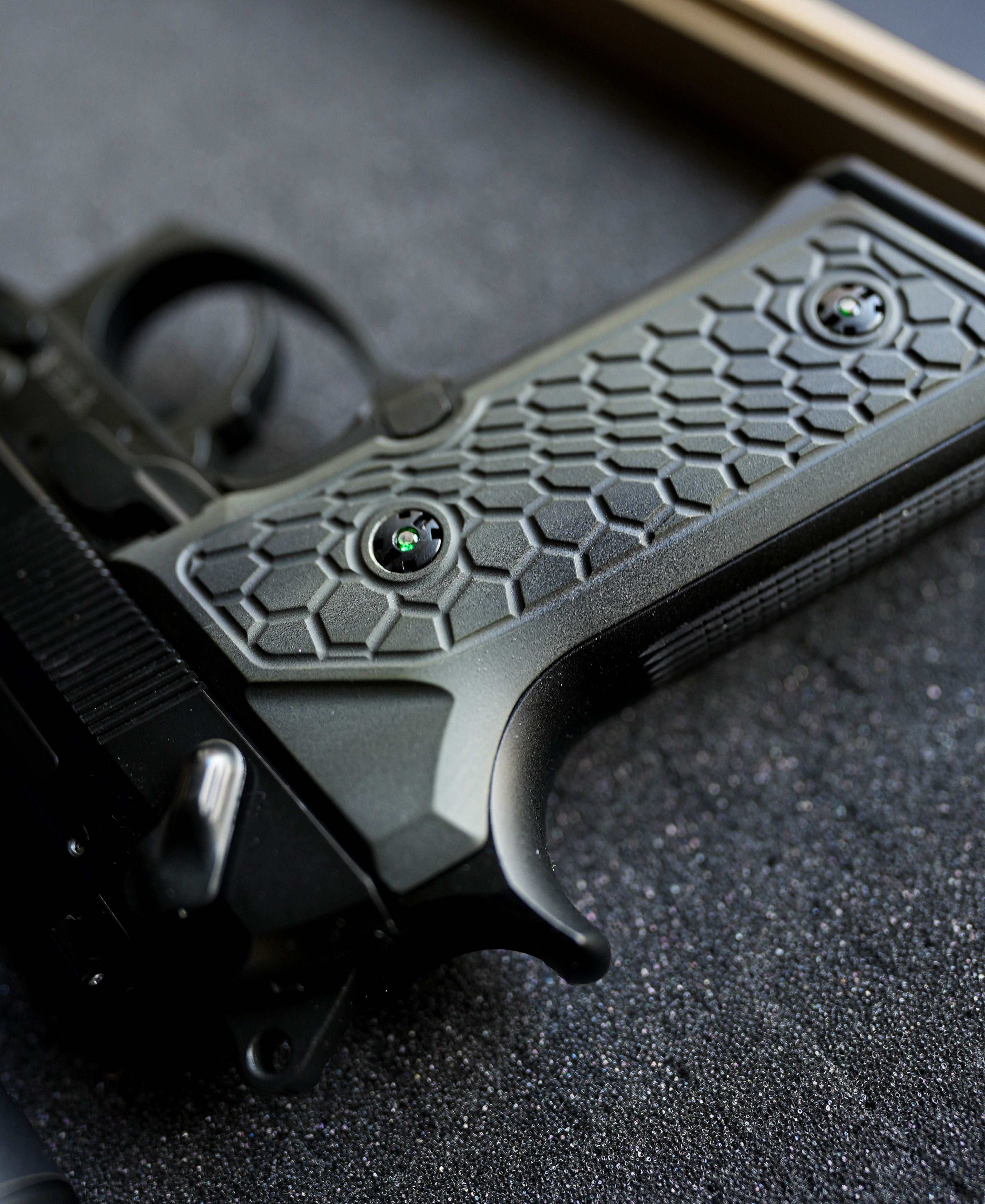
What we consider "basic" texture, our Hexwave series: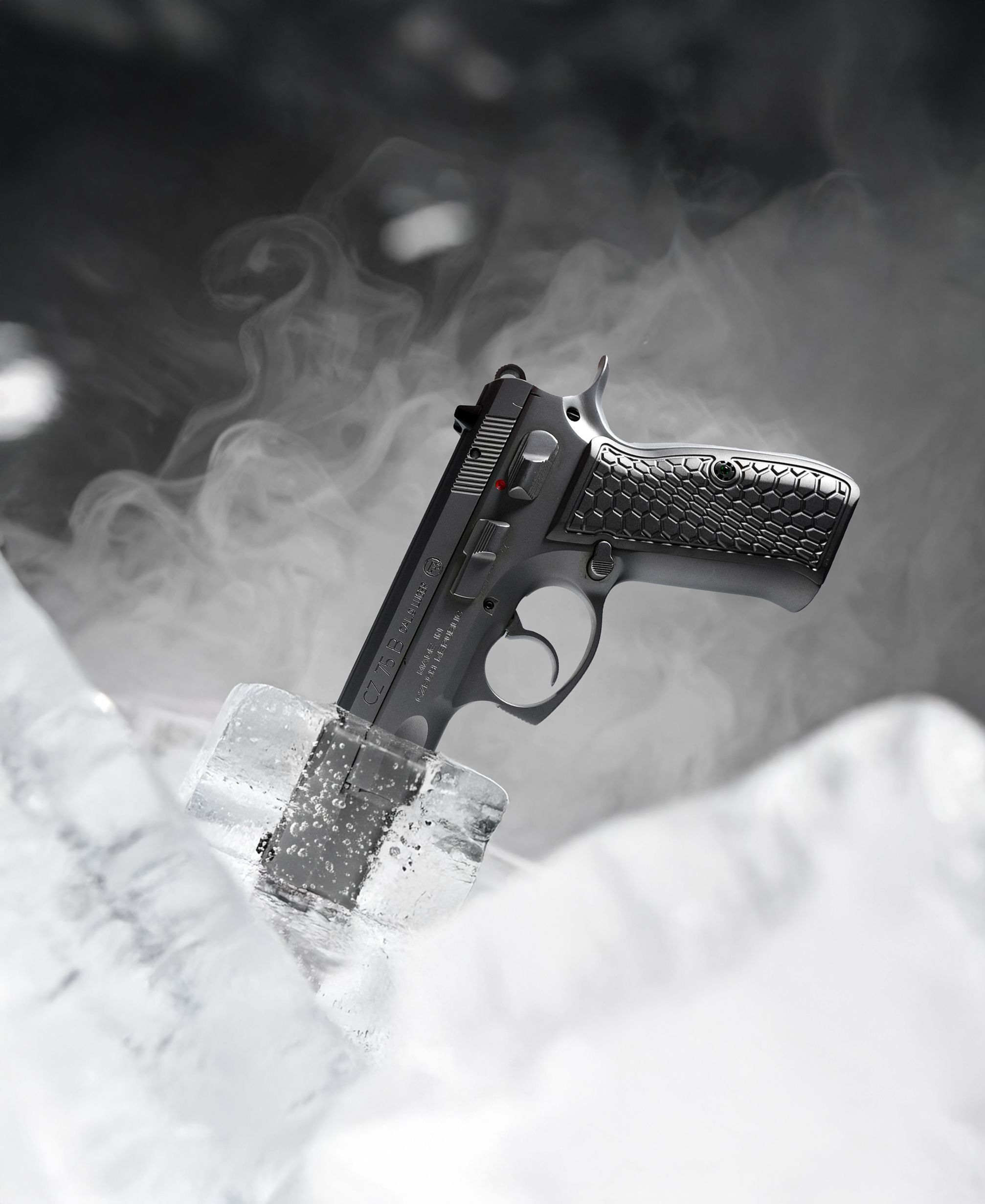
Function Still Matters
There is an important point underneath all of this:
Artwork doesn't excuse bad design.
These are still pistol grips.
Screw locations have to be correct.
Fitment has to be correct.
Clearances have to work.
Edges have to make sense.
And when a pattern is intended to create meaningful grip texture, it needs to actually provide texture.
That's why translating artwork into a physical grip can require iteration.
Something can look incredible on a computer screen and feel completely different once you put it into your hand.
Sometimes details need to become deeper.
Others need to be softened.
Spacing may need to change.
Elements may need to move.
The design isn't really finished simply because the artwork is finished.
It's finished when the artwork works in metal.
From Illustration to Functional Art
That's really what we're trying to create.
Functional art.
The phrase gets thrown around a lot, but for us it has a very literal meaning.
The decorative element isn't merely sitting on top of the functional object.
The decorative element is performing part of the function.
The skull, scroll, armor, geometric line or character you're looking at isn't only there to be seen.
The contours of that design are interacting with your hand.
That is what makes this style of engraving different from simply decorating a grip.
The Same Artwork Can Become Completely Different Grips
One of the most interesting things we've discovered is how dramatically the same design can change depending upon material, platform and finish.
Take one piece of original artwork.
Engrave it into black aluminum and it has one personality.
Put it into anodized red aluminum and it changes.
Machine it into polished copper and it changes again.
Add an aged copper patina and suddenly the recessed details can look as though they've been there for decades.
Put the design into anodized Grade 5 titanium and it becomes something entirely different again.
Then move that artwork from a 1911 grip to a Beretta grip or CZ grip, and the composition itself has to adapt to an entirely new shape.
That's why we don't really think of engraving as simply another finish option.
It's a design system.
Mass Production Wants Repetition. Art Wants Personality.
Manufacturing generally rewards simplicity.
Fewer operations.
Less machine time.
Fewer finishing processes.
Maximum repeatability.
And there is nothing wrong with that.
It's how you efficiently manufacture millions of extremely useful products.
But sometimes efficiency isn't the only goal.
Sometimes you want the complicated version.
Sometimes you want the unnecessary detail.
Sometimes you want to take a perfectly good piece of aluminum, copper or titanium and spend a ridiculous amount of effort engraving artwork into it simply because the finished piece makes you grin.
That's where we live.
More Than Something to Hold Onto
A pistol grip has a simple job.
It gives you a surface to hold.
There are thousands of ways to accomplish that.
Our goal has never been to pretend that ours is the only way.
It isn't.
Our goal is to explore how far you can take something as seemingly simple as two grip panels.
Can the material be unusual?
Can the finish be something you don't normally see?
Can the engraving have depth?
Can the artwork tell a story?
And can all of those things come together without forgetting that somebody still has to pick it up and hold it?
For us, that's the challenge.
And more often than not, it comes back to the same idea:
Don't put texture around the artwork.
Make the artwork the texture.
That's the Wicked Grips approach.
Behind the Grips
This article is part of our Behind the Grips series, where we take a closer look at the materials, artwork, machining and finishing processes behind Wicked Grips.
Continue reading:
Copper Pistol Grips: When a Functional Part Becomes Functional Art
What Goes Into a Premium Pistol Grip? Materials, Art, Machining & Hand Finishing
Explore Wicked Grips deep engraved 1911 grips, Beretta grips, CZ grips, copper grips and titanium grips at WickedGrips.com.