What Goes Into a Premium Pistol Grip? Materials, Art, Machining & Hand Finishing
Posted by Ed strange on Aug 27th 2026
What Goes Into a Premium Pistol Grip? Materials, Art, Machining & Hand Finishing
We occasionally hear that Wicked Grips are expensive.
Compared with a basic, mass-produced set of pistol grips, that's absolutely true.
But they're also very different products.
There is a tremendous difference between machining a repeating texture into an inexpensive material and creating a grip from solid copper or Grade 5 titanium, developing original artwork for it, engraving that artwork deeply into the metal, and then individually finishing the piece with polishing, anodizing, PVD or a hand-applied patina.
At Wicked Grips, we've never tried to build the cheapest pistol grips we can make.
We try to build grips that make you pick up a pistol, look at it and say:
"Damn. I've never seen anything like that before."
And making that kind of product takes more.
It Starts With the Material
Before a machine ever makes its first cut, there is already a significant difference between premium metal grips and grips manufactured from more economical materials.
We work extensively with solid copper, Grade 5 titanium and aluminum.
These aren't simply different colors of the same product. Each material has different costs, machining characteristics, finishing possibilities and aesthetic qualities.
Solid Copper
Copper is one of our favorite materials because there is really nothing else quite like it.
It's heavy. It has warmth and depth. It can be polished to a beautiful red-gold appearance, darkened to rich browns, or chemically aged into dramatic blues, greens, purples and other colors.
It is also an expensive material from which to manufacture pistol grips.
Our copper grips begin as solid copper billet. We machine away material to create the actual grip panels, then perform whatever additional engraving and finishing that particular design requires.
And unlike a coating intended to imitate copper, when you hold one of our copper grips, you're holding the real thing.
That difference has a cost.
It also has a completely different character.
Titanium Is an Entirely Different Animal
Then there is titanium.
We use Grade 5 titanium for many of our premium grips and components.
Titanium is an extraordinary material, but it isn't inexpensive—and it isn't chosen because it makes manufacturing easier.
We use it because of what it allows us to create.
Titanium can be precisely machined, engraved and anodized into an incredible range of appearances. Depending upon the design and finishing process, we can create everything from relatively understated metal finishes to brilliant blues, bronze tones and multicolored effects.
Some of our titanium grips combine multiple materials and individually finished components into a single design.
That's a very different manufacturing philosophy from making the fewest possible operations on the least expensive material.
We aren't choosing materials based solely on what makes a grip cheaper to produce.
We're choosing them based on what makes the finished product extraordinary.
Case in point... Our 1911 Hybrid is 4 separate machined pieces, with deep engraving and constrasting finishes. It takes more time, tooling, design, polish, fitment and final finish to create something truly unique.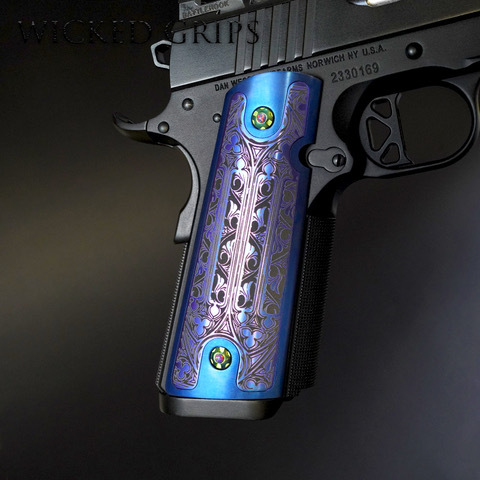
Aluminum Isn't Just "Aluminum"
Aluminum allows us to create a lighter metal grip while still giving us an excellent canvas for deep engraving and specialty finishes.
But even here, there is an important distinction.
A material can be relatively affordable while the work performed on that material is not.
A blank aluminum grip panel is one thing.
A precision-machined aluminum grip that has subsequently been deeply engraved with original artwork, hand finished and given a specialty coating or finish is something very different.
The raw material is only one part of the finished cost.
Our Aluminum grips receive hours of machine work and handwork to achieve this level of detail and color: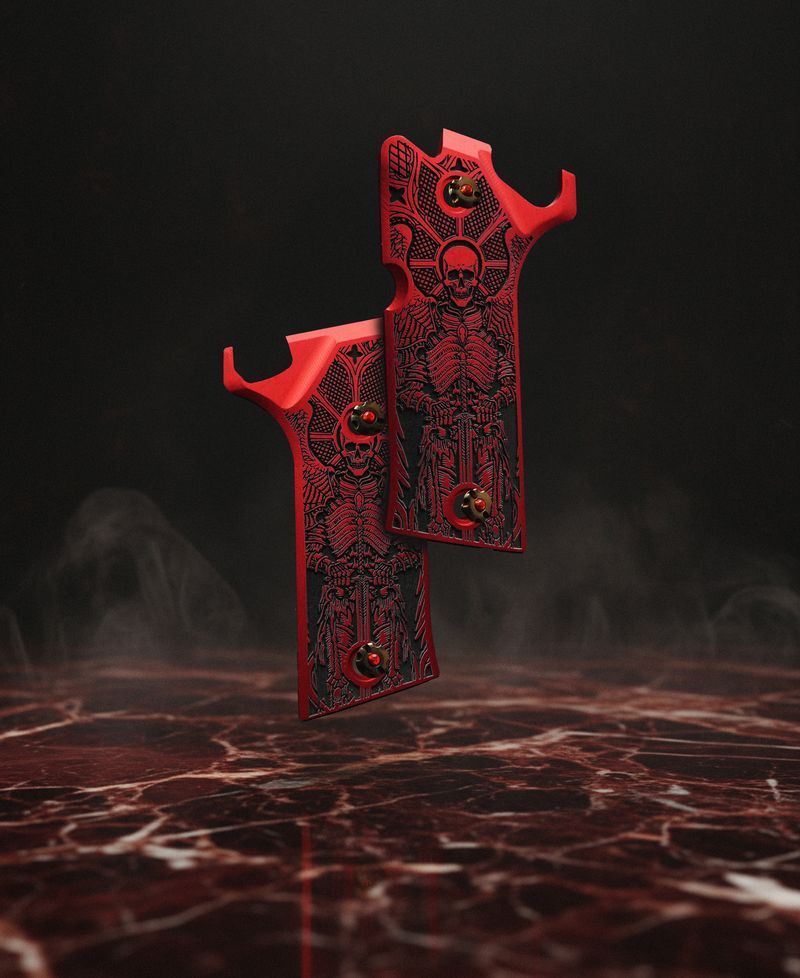
CNC Machining a Texture vs. Engraving Artwork
This may be one of the biggest differences between what we do and many conventional pistol grips.
A CNC machine is exceptionally good at repeating geometry.
Program a pattern of lines, diamonds, circles, hexagons or other shapes and the machine can reproduce that texture over and over again.
There is nothing wrong with that. It is an extremely effective way to manufacture a functional grip texture.
But we wanted to do something different.
We wanted the art to become the texture.
Many Wicked Grips designs begin as actual artwork.
Instead of simply cutting a conventional repeating texture into the grip and then placing a decorative image somewhere else, we design artwork that can perform both jobs.
The artwork has to look good.
It has to fit the unusual shape and dimensions of a pistol grip.
It has to translate successfully from two-dimensional art into machined metal.
And the depth, spacing and details have to create a surface that actually feels good in the hand.
That's considerably more involved than telling a CNC machine to repeat the same geometric feature across a surface.
Someone Has to Create the Art
This is one of the easiest costs to overlook because you can't weigh it on a scale.
Original art has value.
Many of our engraved patterns are created in-house by our artists specifically for Wicked Grips.
That means someone has to conceive the idea, draw it, revise it, adapt it to the grip, prepare it for engraving, test it and sometimes modify it again after seeing how the design translates into actual metal.
A complex engraved design doesn't magically appear because we own a CNC machine or engraving equipment.
The machine can reproduce instructions with incredible precision.
It cannot replace the creative work required to decide what those instructions should create.
It's the same reason an engraved watch, piece of jewelry or custom knife isn't valued only according to the cost of the metal from which it was made.
Craft and design have value too.
Our main artist is Kade Strange, a high honors Graduate of CCS in Detroit, with years of fine art, modeling and design under his belt. 
Deep Engraving Takes Machine Time
There is another misconception about CNC manufacturing:
Once something is CNC machined, it must be cheap to make.
That's not necessarily how manufacturing works.
Machine time costs money.
Tooling costs money.
Setup costs money.
Tool wear costs money.
Multiple operations cost money.
And the more material that has to be precisely removed, the more time a machine may spend producing a part instead of simply putting a shallow mark on its surface.
Our deeply engraved designs aren't simply printed graphics.
We physically machine the design into the metal.
On patterns such as Tesserae, Gothic, Valkyrie, Pax Per Mortem, Redrum and Hex Matrix, the depth and geometry of the artwork are intentionally used to create physical texture.
You're seeing the artwork.
You're also feeling it.
Then the Machine Stops—and the Work Doesn't
This is another major difference between mass production and what we do.
The part coming out of the machine isn't necessarily the finished product.
Depending upon the grip, there may still be polishing, cleaning, preparation, anodizing, coating, patina work, selective polishing, assembly, inspection and photography ahead.
Some of our finishes involve substantial hands-on work.
Our Shipwreck Copper is a perfect example.
We deliberately accelerate the natural oxidation characteristics of copper to develop the blues, turquoise, greens and darker tones associated with aged copper and bronze.
The process can take many hours.
Then the grips are individually hand finished to expose portions of the underlying copper and bring out contrast and color.
And there is another complication:
Patina doesn't believe in mass production.
You Can't Tell Patina to Make the Same Grip Twice
We can control the process.
We cannot tell oxidation exactly where to put every blue streak, dark area or patch of exposed copper.
That's part of the beauty of it.
No two Shipwreck grips are exactly alike.
The same is true of some of our other specialty copper patinas. Colors and patterns develop organically across the metal, which means an especially interesting result becomes its own individual piece.
For many of these grips, we photograph and list the actual individual set for sale.
Think about what that means from a manufacturing standpoint.
Instead of making 500 identical products, taking one photograph and putting them into identical boxes, we're creating pieces that may require individual finishing, inspection, photography and listing.
That isn't the most efficient way to manufacture something.
It's simply the way to make the product we want to make.
Small-Batch Manufacturing Changes the Equation
Volume matters tremendously in manufacturing.
If you're making enormous quantities of the same part, setup, programming, tooling, artwork and other costs can be spread across thousands—or hundreds of thousands—of units.
That's one of the reasons mass-produced products can be inexpensive.
Wicked Grips operates differently.
Many of our products are manufactured in relatively small batches. Some finishes are produced in extremely small quantities. Certain patina sets are effectively one of one because the exact finish cannot be duplicated.
We're comfortable with that.
We aren't trying to put the same grip on every pistol in America.
We'd rather make something that causes another person at the range to ask:
"Where did you get those?"
Made in America Means Something to Us
Wicked Grips has been making custom pistol grips in the United States for more than two decades.
We could make different choices.
We could simplify designs.
We could eliminate expensive materials.
We could reduce hand finishing.
We could outsource more processes solely to reduce costs.
We could follow whatever design happens to be selling well and make our version of it.
That would probably make some products less expensive.
It just wouldn't be Wicked Grips.
Our goal has always been to create products we're excited to make and that our customers are excited to own.
Are Expensive Grips "Worth It?"
That's entirely up to you.
And we're comfortable saying that.
If your only requirement is two panels that fit your pistol and provide basic texture, there are plenty of inexpensive grips on the market that will do exactly that job.
We aren't going to pretend otherwise.
Wicked Grips are for the person looking for something beyond that.
They're for someone who appreciates solid copper instead of copper-colored material.
Grade 5 titanium instead of a titanium-colored coating.
Original engraved artwork instead of another repeating texture.
Hand-developed patina instead of printed color.
Small-batch production instead of mass production.
And something that might look as interesting twenty years from now as it does today.
You're Not Just Paying for the Metal
Ultimately, the price of a premium grip isn't simply the cost of the material.
You're paying for the material that went into it.
The material machined away from it.
The tooling used to cut it.
The machine time required to produce it.
The artwork someone created for it.
The engraving that put that artwork into metal.
The finishing process that gave it character.
The hands that polished and finished it.
And the willingness to make something in small quantities simply because we think it's worth making.
We understand that Wicked Grips won't be for everyone.
They're not supposed to be.
For more than two decades, we've tried to make pistol grips for people who don't want what everyone else has.
Sometimes that means using more expensive materials.
Sometimes it means spending more time at the machine.
Sometimes it means spending hours creating a patina that we'll never be able to duplicate exactly again.
And sometimes it means taking the harder and more expensive route simply because the finished product is better for it.
That's what you're paying for.